AI Audits vs. Save-Time Validation: Which Produces Cleaner Rental Books?
Learn how weekly AI audits compare with save-time validation in rental bookkeeping, including accuracy, error prevention, repair quality, and efficiency.

Article Summary
- 01
Across 15 runs of a fictional rental bookkeeping quarter, weekly AI audits averaged 1.4 final validator findings, compared with 10 for save-time validation and 3.0 for a hybrid of both.
- 02
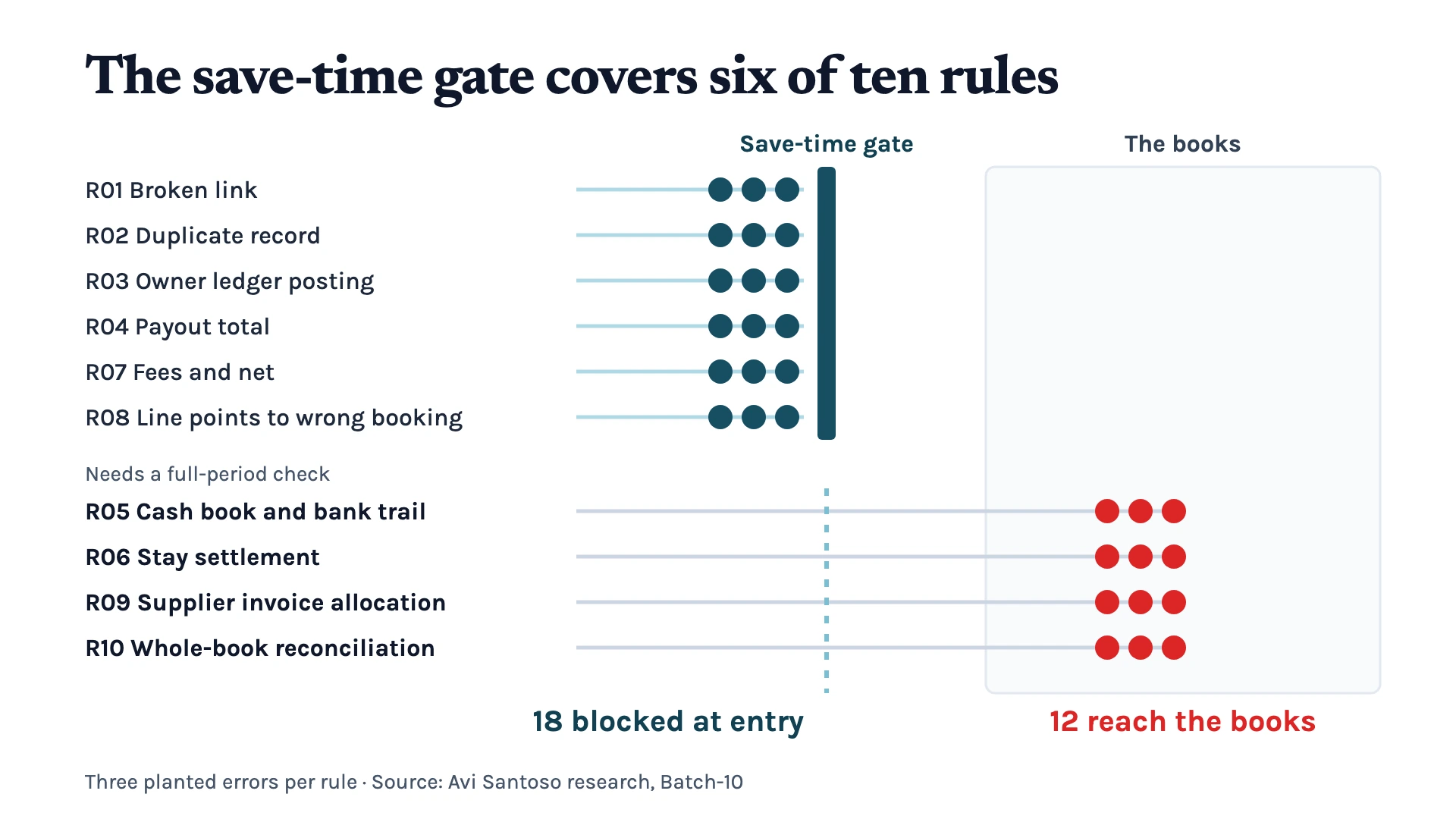
Save-time validation blocked 18 of 30 planted errors before they reached the books, but the other 12 needed full-period checks such as cash trails, stay settlement and reconciliation.
- 03
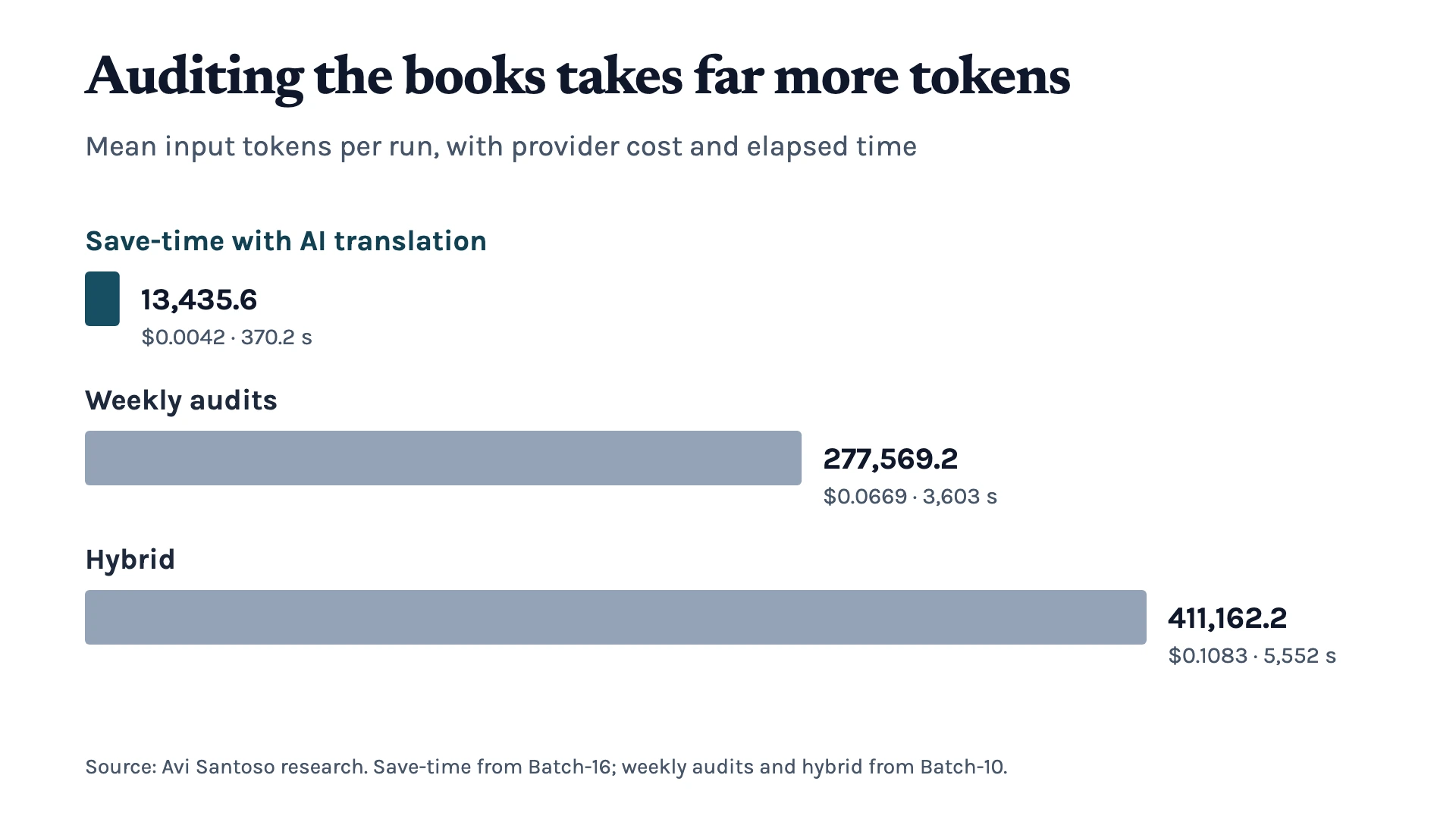
Save-time validation with AI translation used about 21 times fewer input tokens than weekly audits, cost about 16 times less and took about one-tenth of the time.
Do weekly AI audits yield cleaner accounting records than checking every transaction prior to saving? This question is the subject of our most recent independent research at Avi Santoso, which we tested in a controlled experiment using made-up short-term rental bookkeeping. What the results show is an important trade-off among operating costs, error prevention, and data quality.
This AI audits vs. save-time validation study compares final findings, error prevention, and resource use.
Across 15 runs, weekly audits averaged 1.4 final validator findings. By way of contrast, save-time validation on its own averaged 10 findings, and a hybrid of the two approaches averaged 3.0. In four out of five instances, the weekly audit run had zero findings to report.
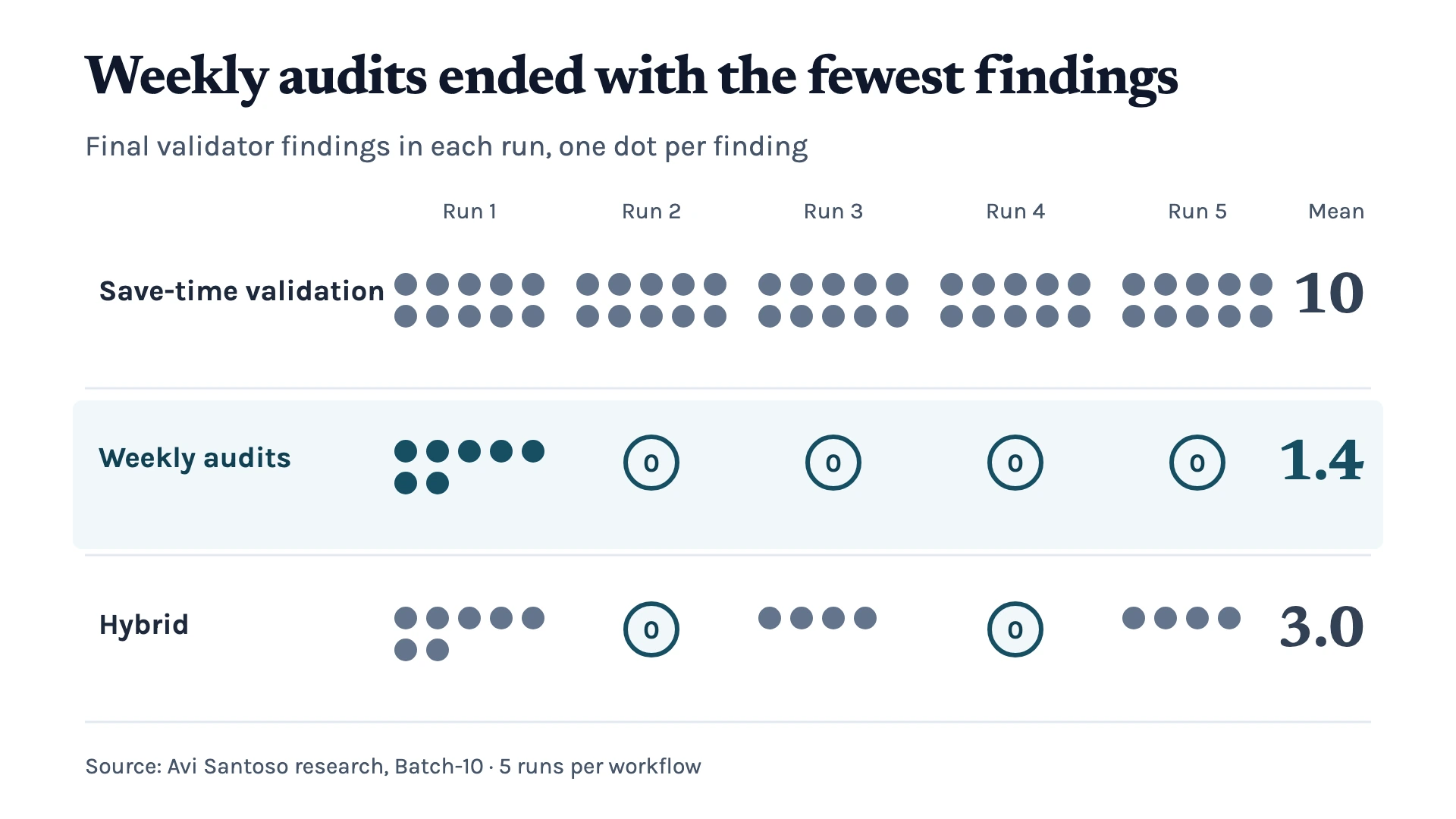
Yet the most resource-efficient workflow did not necessarily produce the cleanest books. Another experiment showed that with AI translation, save-time validation was faster, cheaper, and used fewer tokens than any of the audit-enabled workflows.
For businesses looking to automate their bookkeeping, these are relevant findings. Correcting problems with regular review and stopping errors as they come into the system are distinct technical tasks. Each approach has merits, and the design must match the kinds of errors the finance workflow needs to spot. This article will go over the experiment and its results, the technical distinctions between the three workflows, and what limitations a business should have in mind before putting this into practice in real accounting operations.
For bookkeeping automation, the timing of a check affects which problems can be caught immediately and which require later review.
AI Audits vs. Save-Time Validation: Research Findings
What Did the Experiment Find?
We compared three workflows over the course of a fictional 13-week rental quarter from July 1 to September 30, 2026. Each was given 30 planted errors and eight valid but odd events to handle. With 13 weekly checkpoints per run and five runs apiece, we had 195 checkpoints across 15 total runs.
Weekly AI audits had the lowest average of final validator findings. But the three workflows went about it in different ways. Save-time validation put a stop to 18 of the 30 planted errors before they could be put in the books; the other 12 were left unresolved at the end of each run as they called for checks outside the gate’s rule set.
The weekly audit let all 30 in at first. Its agent would then look at the source records and validator findings and put forward repairs during the quarter. In four of the five runs, there were no open planted errors by the time it was done. The hybrid blocked the same 18 as the save-time method and added weekly reviews, but still averaged 3.0 final findings.
It is clear from the results that a periodic review can turn up what entry-time checks overlook. That does not mean a weekly audit will be superior in every accounting setting.
| Workflow | Planted errors blocked at entry | Final findings, runs 1–5 | Mean final findings | Runs ending at zero |
|---|---|---|---|---|
| Save-time validation | 18 of 30 | 10, 10, 10, 10, 10 | 10 | 0 of 5 |
| Weekly audits | 0 of 30 | 7, 0, 0, 0, 0 | 1.4 | 4 of 5 |
| Hybrid | 18 of 30 | 7, 0, 4, 0, 4 | 3.0 | 2 of 5 |
Source: Avi Santoso research, Batch-10.
How Save-Time Validation and Weekly AI Audits Work
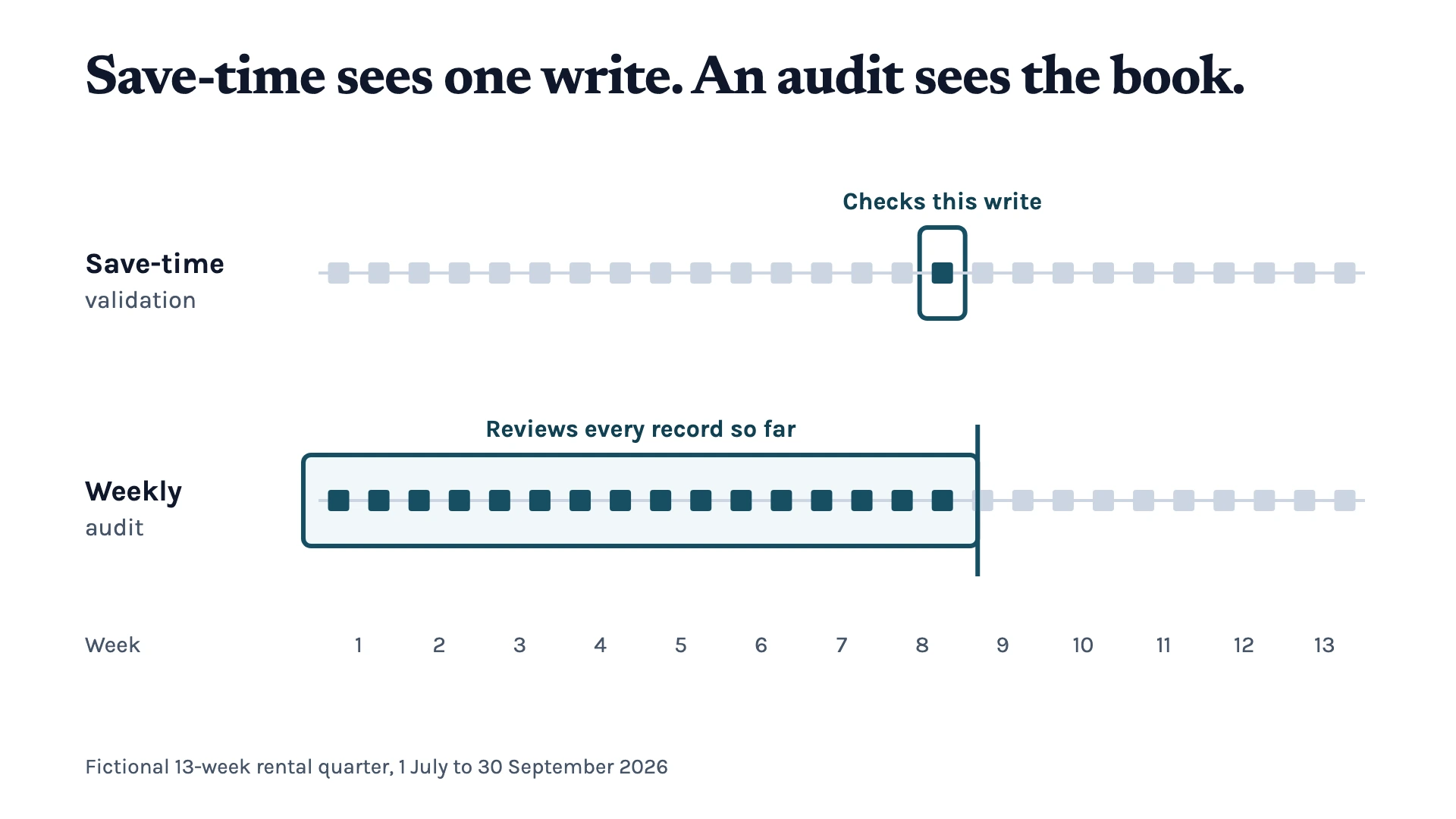
The difference is one of timing and how much information is available to be examined. The AI audits vs. save-time validation distinction is mainly about when checks happen and how much evidence is available.
Save-Time Validation Prevents Errors at Entry
Before accepting a change, save-time validation runs it through predefined rules. The system applies an attempted write to a temporary version of the books and tests the state. If the candidate records break a rule, the system logs the failure and rejects the write, leaving the books unchanged.
Our experiment checked for settlement arithmetic, matching owner-ledger postings, unique business keys, known property links and valid values. A booking to a non-existent property, for instance, can be turned away on the spot. Then again, some issues cannot be judged when a record first comes in. A payout may seem in order even if the bank deposit has not shown up yet. So entry validation is not a substitute for a full-period review; it is only as good as the evidence and rules at hand.
Weekly AI Audits Find Problems Across Records
At scheduled intervals, the weekly audit looks at the accumulated records. The agent is not confined to the latest transaction but can probe the connections between invoices, bank activity, settlements and bookings.
During the experiment, the audit agent read the findings, took notes after searching the source exports, and proposed a set of changes. Any proposed repair had to align with the source evidence. The validator was then re-run to see if the findings had been altered. Over ten runs, the agent put in 438 add, set, or delete edits, all of them citing a source record. They amounted to 59 repair bundles, 55 of which were deemed correct and none harmful.
An AI agent for accounting can use source records to investigate validator findings and propose targeted changes.
This is proof that an automated agent can do more than flag an error; it can put forward an evidence-based correction. The classifications were based on the fixture’s repair evidence and the validator’s output before and after the bundle. They were not an independent accounting of the whole dataset. A source record to back a repair does not, by itself, vouch for the correctness of the books.
An AI bookkeeping audit can support review, but repair quality still requires appropriate verification.
Why Rental Bookkeeping Needs More Than Entry Checks
A manager in a short-term rental operation will get records from many places at different times: booking exports, reports from the payment platform, supplier invoices, owner transactions, and so on. The system has to tie them together while allowing for normal timing lags. We had ten fixed validator rules in the experiment to catch things like duplicate bookings and broken property links.
Common Errors Found in Rental Bookkeeping Records
Source: Avi Santoso research, Batch-10. Among the deficiencies noted were missing owner-ledger postings and incorrect payout totals. Some payouts had no cash-book or bank trail, and confirmed stays had not been settled. Some settlements had incorrect arithmetic, money was tied to the wrong booking, and invoice allocations failed to balance. Whole-book reconciliation turned up further differences.
Of these ten rules, the save-time gate applied to six. The other four (R05, R06, R09 and R10) called for full-period checks. As a result, the gate stopped 18 of the planted errors, but 12 involving cash trails, stay settlement, invoice allocations, and reconciliation made it into the books. Weekly audits can probe these using the records at hand, which is why the final tally of findings in the experiment was lower.
An AI bookkeeping audit must distinguish genuine errors from valid timing differences.
Distinguishing Real Errors From Valid Timing Differences
The test also ran eight events that were valid if unusual: a bank deposit that pre-dated its payout report, a supplier credit note and a reversed payment dispute. In the 15 runs of Batch-10, all 120 such observations played out as expected.
Why AI Bookkeeping Audits Need Context
For an AI bookkeeping audit to be reliable, it must distinguish a true error from something that seems odd because of timing or incomplete data. Turning down every incomplete record needlessly slows things down when transactions come in a normal order at variance with the reporting sequence.
Resource Costs: The Trade-Off Between Accuracy and Efficiency
Better data quality in a workflow can be more computationally demanding. The research put provider-reported token usage, cost, elapsed time, and request counts side by side to gauge the disparity. The figures for the weekly audit and hybrid are from Batch-10; those for save-time are from a separate five-run exercise in Batch-16 where AI translation was put in for validation.
The AI audits vs. save-time validation comparison also highlights the need to assess accuracy and resource use separately.
| Mean per run | Save-time with AI translation | Weekly audits | Hybrid |
|---|---|---|---|
| Input tokens | 13,435.6 | 277,569.2 | 411,162.2 |
| Output tokens | 9,050.6 | 137,489.6 | 234,829.8 |
| Provider cost | $0.0042 | $0.0669 | $0.1083 |
| Elapsed time | 370.2 seconds | 3,603 seconds | 5,552 seconds |
| Provider requests | 44.6 | 54.6 | 64.4 |
These resource numbers are batch averages.
In bookkeeping automation, resource use should be measured alongside accuracy and the effort required for oversight.
An AI bookkeeping audit may require more resources when it investigates linked records and unresolved findings.
These resource numbers are batch averages. Save-time validation with AI translation used about 21 times fewer input tokens than weekly audits and cost about 16 times less from the provider’s point of view. On average, it was one-tenth the time. The hybrid workflow registered the heaviest use of resources.
This is only to be expected given what each does. AI translation makes proposed commands of incoming source records. A weekly audit has to go over the books, make sense of the findings, assemble evidence, and put forward repairs. An accounting AI agent can do more involved work than a pure translation process, but that comes at the expense of token consumption and time.
An AI agent for accounting may need more context and processing time when it investigates linked records rather than translating individual arrivals.
One caveat to the comparison is that the two batches were implemented differently. The save-time workflow in Batch-16 ended with 11 findings, compared with 10 in the original Batch-10 version. So the figures are indicative of the set-up rather than proof that auditing is the sole cause of the cost gap.
What the Results Mean for Finance Workflow Automation
The experiment supports a pragmatic approach to building finance systems, where controls are tailored to the error at hand. An AI agent for accounting would benefit from controls that make any proposed changes open to review and traceable. For the purpose of instant rules to block a write-up on account of invalid links, duplicate keys, or an inconsistency in transaction relationships, save-time validation has its merits.
When to Use Save-Time Validation or Periodic Audits
But periodic audits fit better for a broader examination of the books: to verify that records reconcile over the period, spot any unsettled stays, or ensure payouts align with the bank. Where the business requires some errors to be put down immediately, a hybrid may be in order. The results do not indicate that entry controls are superfluous; they only show that the hybrid we tested had fewer total findings than the weekly audit.
The findings can inform an AI bookkeeping audit strategy, but the appropriate controls depend on the accounting risks and operating requirements.
Then there is the matter of incorrect repairs. Financial records call for approvals, access controls, and independent reconciliation. When an automated system can alter records without human sign-off, these safeguards become even more important.
Measuring Accuracy, Repair Quality, and Operating Costs
In evaluating bookkeeping automation, teams should look beyond how many errors are blocked. Remaining findings, the quality of the repair, false positives, operating and processing costs, and the oversight required are all part of the equation. The best design is not always the most AI-intensive. It is the one with the right controls and verifiable evidence for the risks at an acceptable cost.
Limitations of the Research and Areas for Improvement
This study used a single fictional quarter, one seed, three planted instances per validator rule, and five runs per workflow. The results are best viewed as preliminary experimental evidence, not some kind of universal performance standard.
Limitations of the Experimental Setup
Further bookkeeping automation research should test whether the same pattern holds across more quarters and different datasets.
Going forward, it would be wise to test with more than one quarter and different data seeds, as well as other error types and anonymized real-world exports. Extra repetitions would shed light on the reason some audit runs have unresolved findings, and others come in at zero. An independent accounting review would carry more weight; the verdicts here came from fixture evidence and validator changes, not a full independent run-through of the books after each repair.
Future testing should evaluate whether an AI agent for accounting performs consistently across different quarters, error types, and datasets.
Operational Constraints and Areas for Future Testing
Then there are the operational limits the agent ran into. An audit response hit the output-token limit 89 times, prompting 81 retries. Of the 195 checkpoints, 45 saw the audit hit its five-round ceiling with open findings. One could argue that higher limits, better context management, and more testing would show how these constraints affect the outcome.
Another limitation is the distinction between what becomes a final finding and an unresolved planted error. In save-time validation, there were 10 final findings but 12 open planted instances. The weekly audits came in at 1.4 findings and 1.8 open instances on average; the hybrid at 3.0 and 4.2, respectively. These are not interchangeable measures.
Future work should map the final findings back to the errors and put all three workflows through the same batch with a common translation layer and evaluation. It would also be useful to factor in human review time and infrastructure costs, which the current provider-cost numbers omit.
A future evaluation of an AI agent for accounting should map each final finding to its underlying error and use a common test setup.
Such steps would give a firmer indication of an AI agent’s capabilities under varying conditions and datasets.
Conclusion: The Right Controls Make for Cleaner Books
In this rental bookkeeping exercise, the weekly AI audits had the lowest average of final validator findings. At 1.4 per run, the audit workflow is well below the 10 for save-time validation and the 3.0 for the hybrid. A separate look at resources turned up another advantage to save-time validation with AI translation: it is faster, cheaper, and uses fewer tokens than the audit-enabled options.
For any business looking to automate finance workflows, the difference is clear: stopping known errors versus reviewing a complete set of records to find problems. Both have their value and their price. This is an initial comparison, not a demonstration that one is superior to the other. Real operations will require larger data sets and like-for-like testing to confirm these results.
At Avi Santoso, we are interested in how technology can be made to work for finance operations. We do so with evidence-based testing and a close eye on process improvement and the merits of automation. Our aim is to get a handle on not just the capacity of automated systems but their reliability and efficiency as well.
Our bookkeeping automation research focuses on practical process improvements supported by measurable results.
To see what we come up with in future finance automation research, join our email list. We will send you new findings and some practical thinking on AI and accounting workflows, and keep you posted on our efforts to make financial operations more measurable and dependable.
Keep up with what I'm working on
I'll send you occasional emails about new articles, tools and offers that could help with your business.