Month-End Close and Reconciliation
Improve month-end close reliability with clearer source readiness, reconciliations, review controls, and reporting workflows.
Contact us
The month-end close shouldn’t feel like a war
As the end of the month approaches, everything feels like a fire drill. Another emergency alert sounds before the last one is resolved. The reporting deadline gets closer, but a source report is still missing. Payroll figures arrive late, and old reconciling items have no clear owner. Reviewers also ask for support that preparers believed they had already finished. 1
These aren’t isolated problems, because the same ones return each month. Beneath them, there’s usually a workflow issue. Ownership is unclear, cut-offs are missing, hand-offs are weak, or nobody can see what’s blocking the close. 1
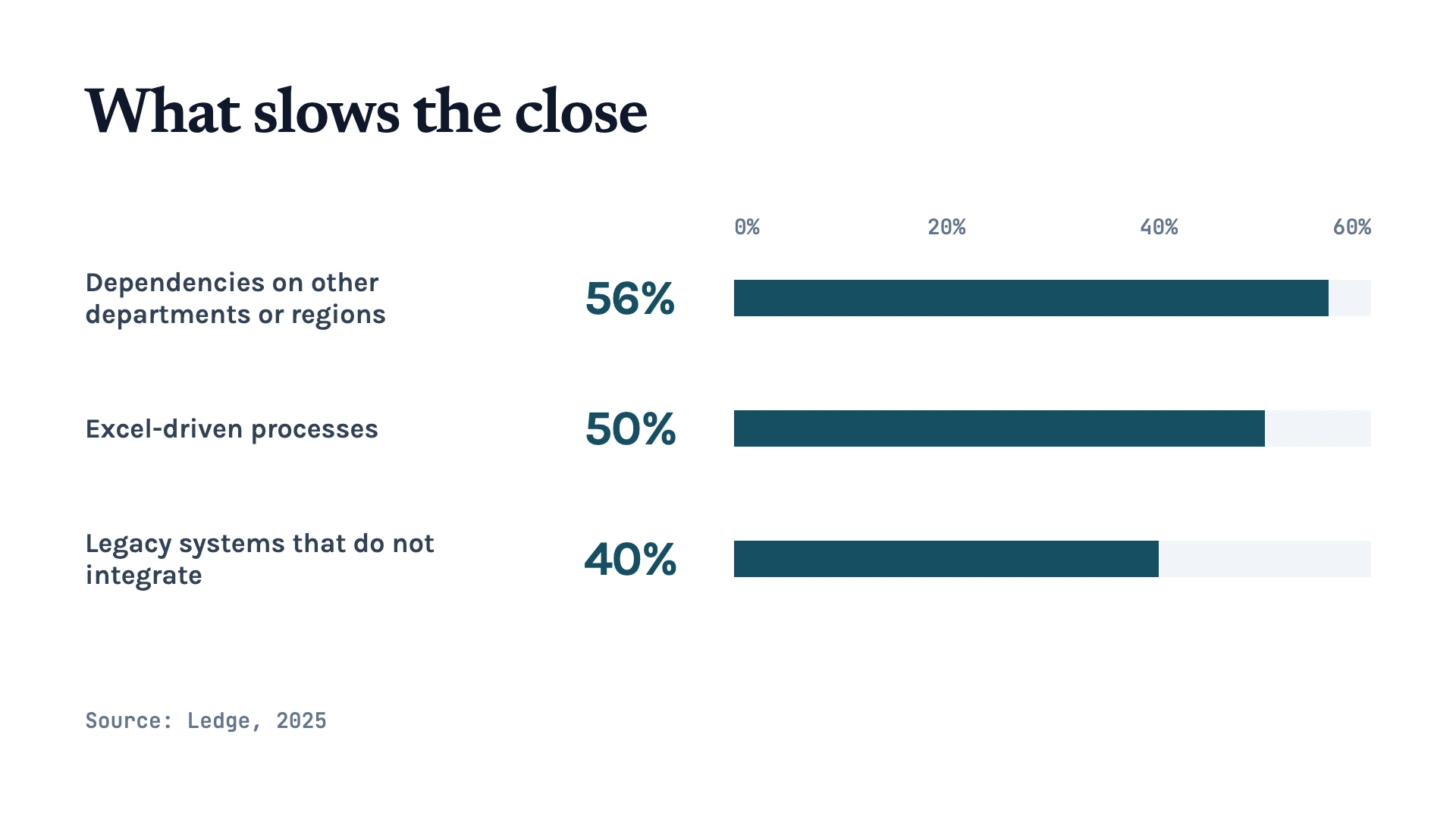
Does a month-end close have to be this chaotic?
A late close can start at the beginning of the month
Consider this a fictional example.
Let’s say your business is a growing distributor. You have a cloud accounting system, bank feeds, payroll, a payment processor, and a few spreadsheets for inventory.
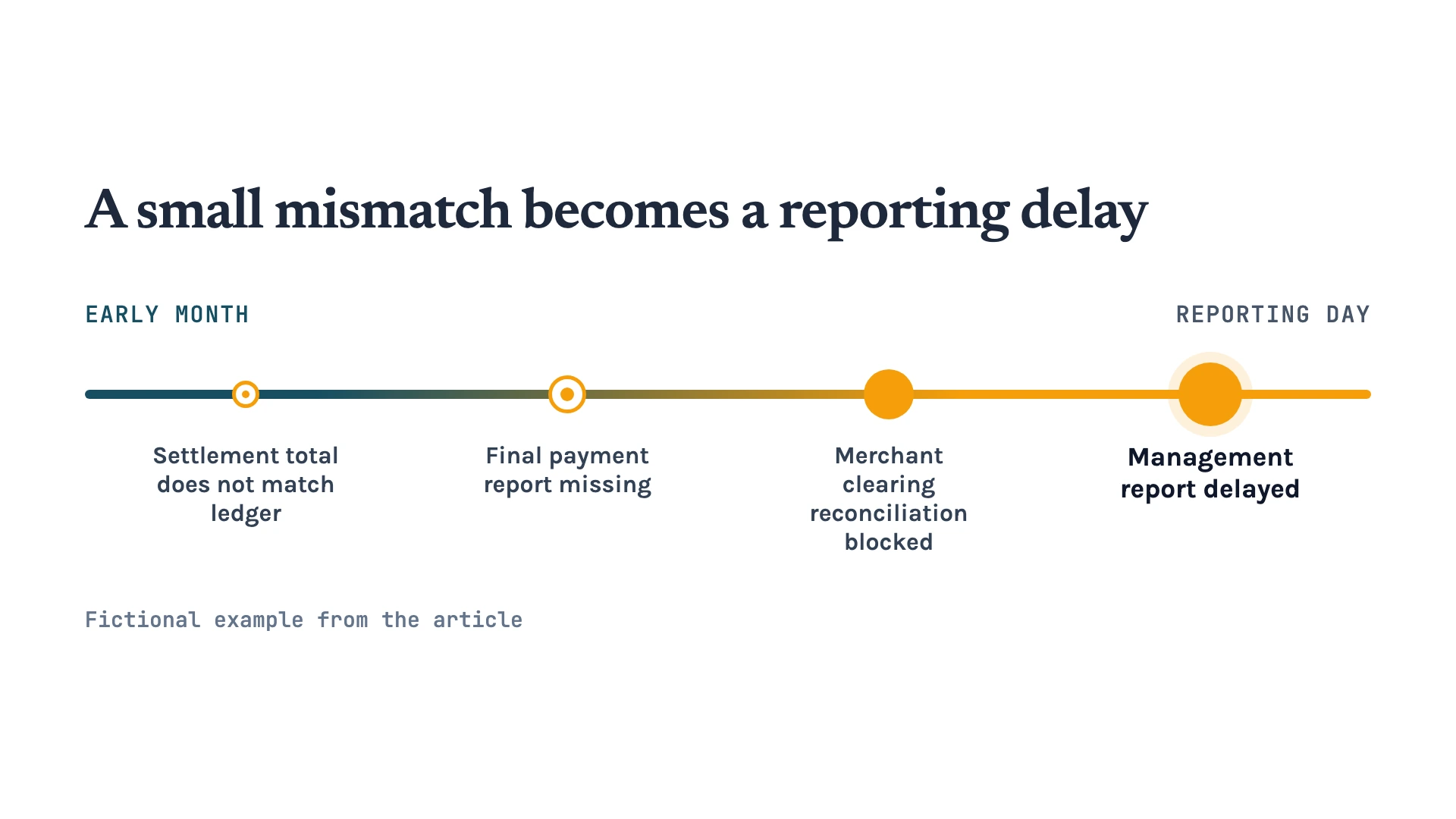
Early in the month, the total from one payment processor settlement doesn’t match the amount recorded in the general ledger. It doesn’t look too scary at first. Someone can check it later during the close once the pressure eases, right?
Except later comes quickly, and no one notices it.
By month end, the final payment report is still missing. The missing report keeps the close preparer from finishing the merchant clearing check. The ledger total still differs from available records for the current period. The tracker says “in progress,” but that doesn’t explain much.
The team now has to find the cause of the mismatch. The final payment report may be incomplete. The processor may have recorded the settlement in one period while the ledger records it in another. A transaction may also be mapped to the wrong account. The close owner then has to assign someone to investigate and resolve the mismatch.
The reviewer only sees the incomplete reconciliation when the numbers are already meant to be ready. They ask for more support, an adjustment journal may need to be posted, and the management report moves again.
The delay began early in the month when one small issue had no clear owner, explanation, or next step. Small triggers like this keep rolling until they become a huge snowball at month end. That snowball grows because the team finds each problem after the next task already depends on it. Reporting day is when the team finally sees how much work has built up.
A longer checklist leaves the workflow problems in place
Extra checklist tasks add activity while the underlying workflow problems remain. Missing information, unclear ownership, and evidence gaps continue to hold back the close and delay the final report.
A task can be marked complete while the balance behind it remains unexplained. 2 A reconciliation can sit “in progress” for days. Nobody can tell whether it’s waiting for a report, approval, a source-system correction, or an answer from another team.
That’s why we map the entire close as a connected flow, starting with source readiness and continuing through to final reporting.
We look at:
- source inputs, cut-offs, and who owns the next action;
- whether ledger balances agree with independent sources;
- how old reconciling items, late journals, and post-review changes are tracked; and
- where spreadsheets, system mappings, or hand-offs create rework.
Upstream controls also affect the month-end close. Delays in accounts payable workflows and payroll processes can create problems long before the finance team begins final reporting. 3
Before the reporting deadline arrives, the finance lead should be able to answer three questions. What’s ready, what’s blocked, and who needs to act next?
What Changes Once We Find the Problem
The team sorts unfinished tasks into three clear states. This gives everyone a clearer view of each problem and the next action. Some work can’t start because an input is missing. Other work is in progress with a known difference, or complete with evidence ready for review.
A close calendar connects reporting dates, cut-offs, dependencies, and due dates. A dependency map then shows what each reconciliation needs before it can begin or finish. 3 This shows whether the team is waiting for a report, investigating a difference, or ready for review.
Clear ownership matters just as much as clear status. Each account and unresolved item needs a named preparer, reviewer, and owner of the source information. 2 For each close task, we identify a backup owner and set a clear deadline for escalating unresolved issues.
The work may also include:
- reconciliation standards that show the account, period, ledger balance, independent source, differences, conclusion, preparer, reviewer, and dates;
- an exception register for unresolved items, including the amount, age, owner, next action, and closure evidence;
- controls for journals and post-close changes, including approval, posting, reversal, and visibility after review; and
- an implementation plan that prioritises the workflow, system configuration, integration, or reporting changes worth making first.
Only after the workflow is clear does automation help. It can collect routine data, send reminders, compare totals, or flag missing evidence before someone has to chase it manually. 4
Automation works best with a clear owner and review point for every action. Your team reviews exceptions, confirms evidence, and controls the final release. This gives each system alert and proposed journal a clear owner and review point. 5
How do you know the close is improving?
An earlier report in your inbox provides one measure of progress based on timing.
An unresolved balance, missing support, or late adjustment can remain in the background after release. When that happens, the same problem continues into the next month and adds work to the next reporting cycle. A better close brings those issues into view early enough for the team to assess, assign, and track them before release.
A better close becomes predictable before it becomes fast.
We set realistic targets from your recent close cycles and the problems found in them. This gives each target a clear starting point. The measures can include:
- time from cut-off to management-report release, including on-time source inputs and reconciliations;
- the age and value of unresolved items, plus review turnaround; and
- late or post-close journals, reopened tasks, and critical blockers.
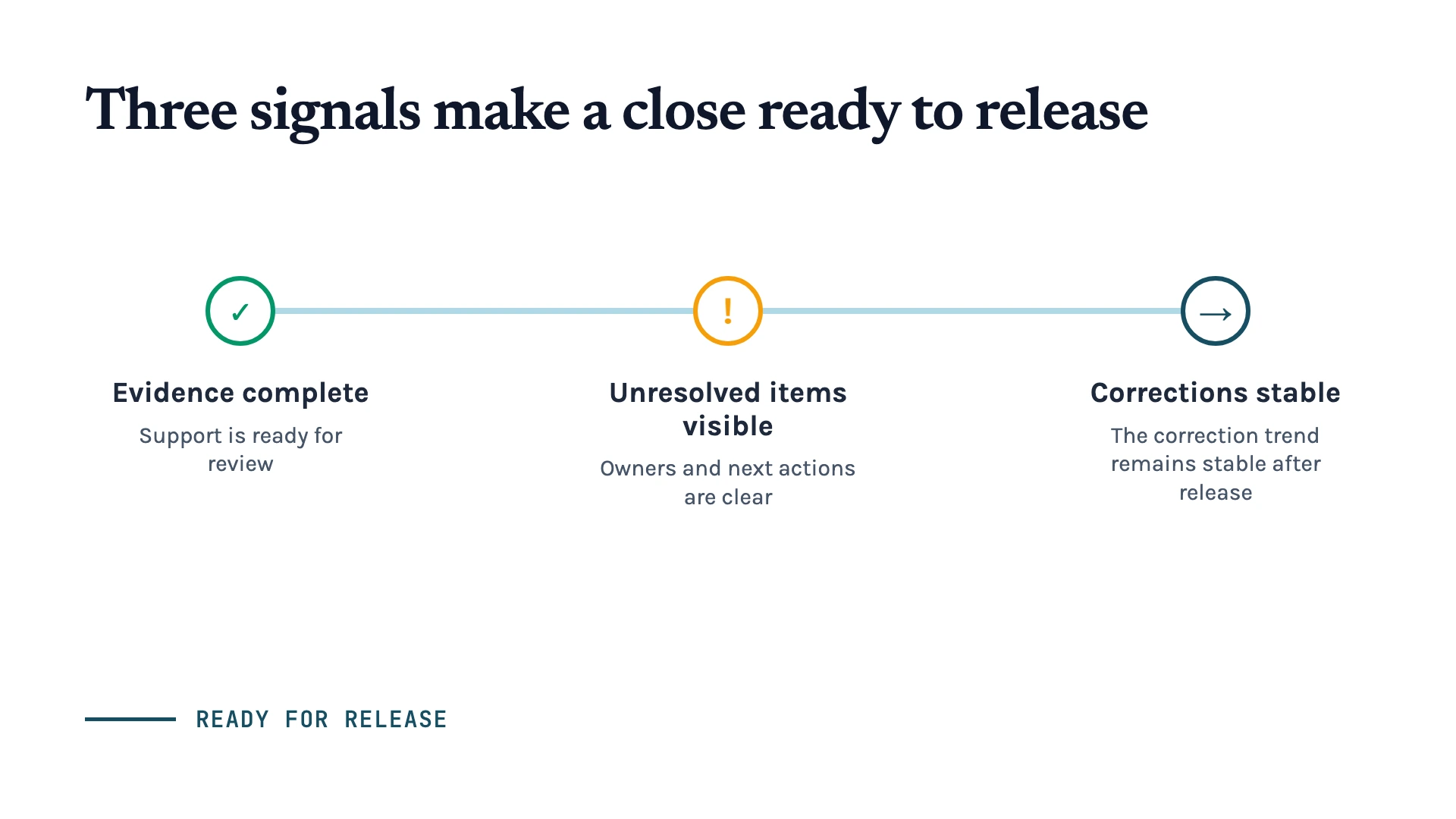
A shorter close needs complete evidence, visible unresolved items, and a stable level of post-close corrections. An increase in corrections shows that the team is carrying the same issues into next month.
Scope and boundaries
We can map the close workflow and design its controls and templates. We can configure systems, build dashboards, support integrations, and test the agreed process with your team.
Your finance team and qualified advisers make the final decisions on accounting policy, tax and BAS positions, materiality, and journal approval. They also remain responsible for financial reporting, audit, and statutory sign-off. Our work supports those decisions through the agreed workflow, controls, and evidence.
The first scope should focus on one defined entity, reporting cycle, and set of material accounts at a time. We can plan bigger work separately when the problem calls for it. That work may include historic clean-up, ERP replacement, or multi-entity consolidation.
Before the next month-end close arrives
By the time it arrives, you should know what’s ready, what’s blocked, and who needs to act next.
A month-end close workflow diagnostic is a starting point for finding the workflow issues behind recurring reporting delays. Tell us about the entity, reporting cycle, material accounts, systems, and close tasks that need attention.
Let’s map what’s happening now and identify the controls, process changes, or system improvements worth addressing first.
References
- Ledge (2025). Month-end close benchmarks for 2025. https://www.ledge.co/content/month-end-close-benchmarks-for-2025
- Cornell University Financial Operations (2024). DFS - Transaction Cycle Narrative: Account Reconciliations. https://finance.cornell.edu/sites/default/files/account-reconciliation-narrative.pdf
- University of Washington Controller’s Office (2026). Month-End Close. https://finance.uw.edu/uco/financial-reporting/month-end-close
- BlackLine (2025). Account Reconciliations. https://pages.blackline.com/rs/blacklinesystems/images/blackline-account-recs-module-overview.pdf
- International Auditing and Assurance Standards Board (2018). ISA 540 (Revised), Auditing Accounting Estimates and Related Disclosures. https://www.iaasb.org/publications/isa-540-revised-auditing-accounting-estimates-and-related-disclosures-9
Related guides
View month-end close guidesThe Difference Between a Month-End Checklist and a Month-End Workflow
Learn the difference between a month-end checklist and workflow, how dependencies and ownership affect close, and how workflows can help reduce month-end close time.
What Is Bank Reconciliation Automation and When Is It Worth It?
Learn what bank reconciliation automation does, how matching rules work, and when automated reconciliation makes sense for your business.
Why Does Month-End Close Take So Long? Common Causes Explained
Find out why month-end close takes so long, from late source data and manual reconciliations to unclear ownership, unresolved items and finance bottlenecks.