Accounts Payable Workflows: Find the Cause Before You Automate
Find where invoices get stuck across intake, approval, exceptions, and payment controls. We help Australian finance firms improve accounts payable workflows.
Contact us
When a valid invoice gets stuck, who's to blame?
In most firms, a stuck invoice isn't one person's fault, and accounts payable rarely breaks for one reason.
A supplier invoice lands in your team's inbox, and the amount on it looks clear. The due date is close, and the goods may already have been received or the service completed. Even so, the invoice still can't move forward.
Maybe there's no purchase order, and your firm requires one for this supplier. 1 Maybe no one has confirmed that the goods turned up or the service was done. Or the invoice went to an approver who's since moved off that cost centre. Sometimes the request simply doesn't give the approver enough to decide on.
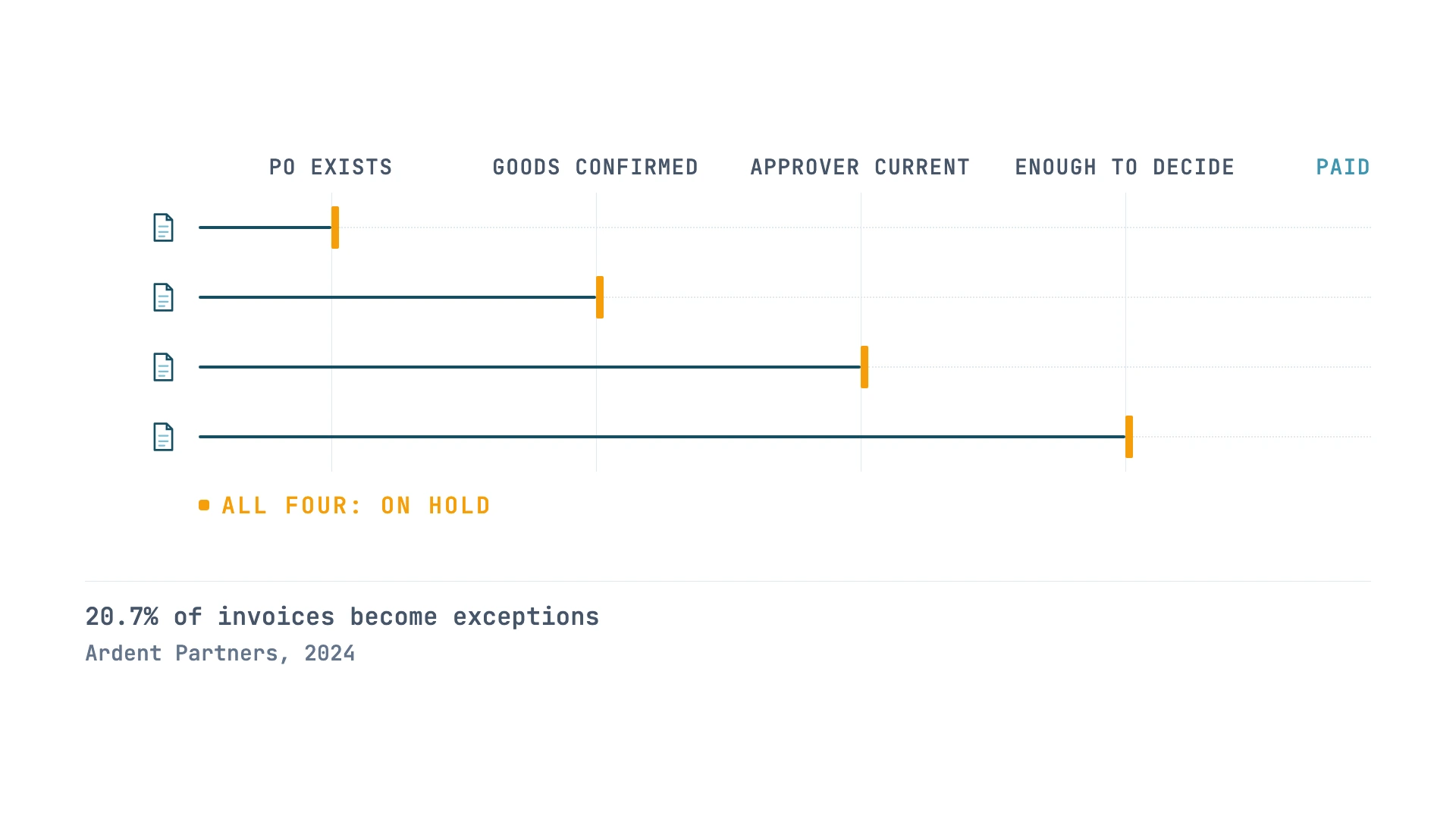
So it sits in an inbox or an on-hold queue while your finance team follows it up. The supplier calls to ask about payment, and the invoice keeps waiting. 2 Eventually someone inside the firm asks for an urgent payment because it has waited too long. 3
That's when the work starts multiplying across the team.
Your team rechecks the invoice details, hunts down the missing evidence, and finds the right approver for that cost centre. Then they reroute the request and work out where the invoice went wrong. One invoice becomes a chain of extra work for everyone who touches it. 2
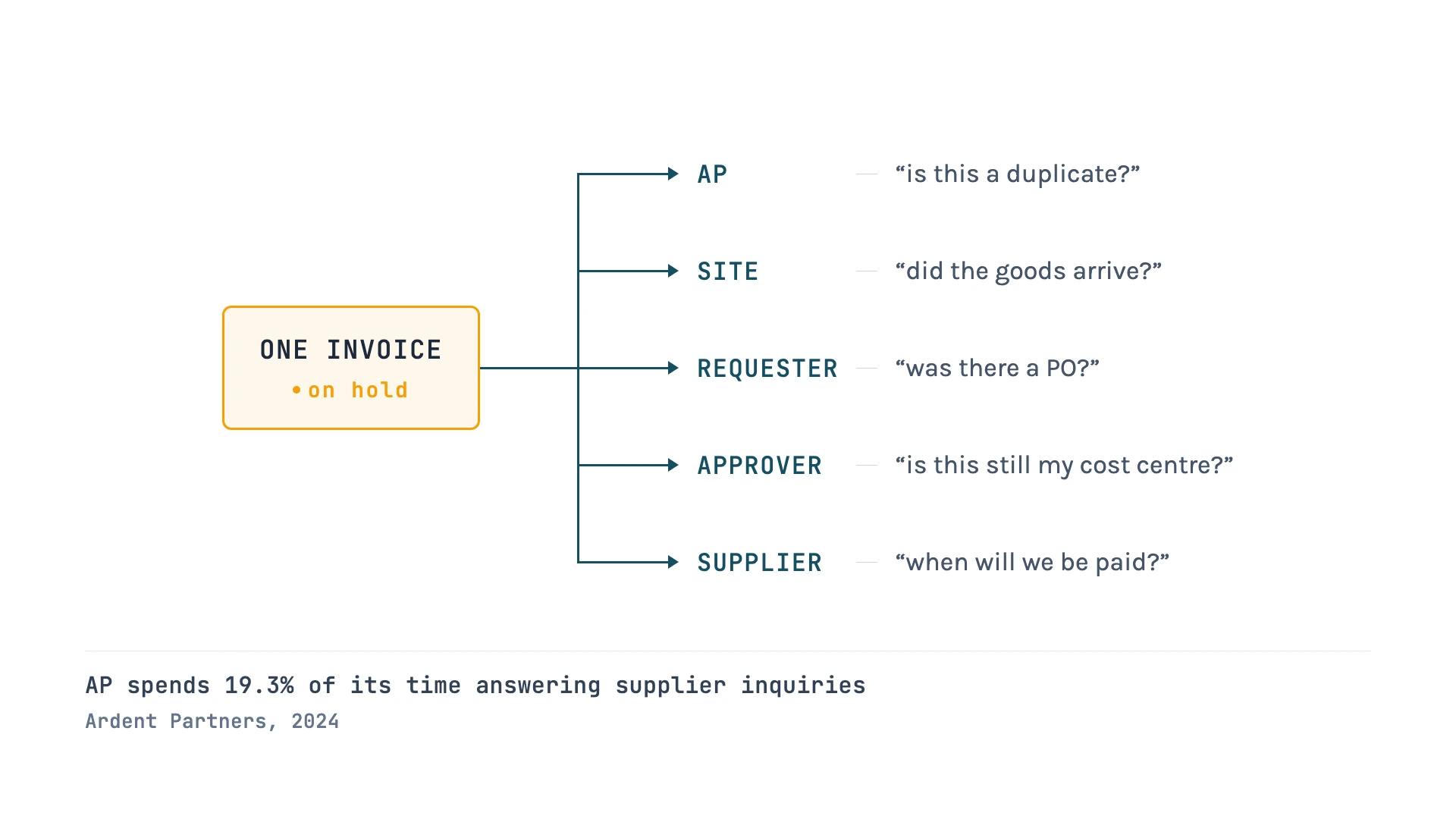
This is rarely a people problem, and far more often it's a workflow problem. 1
If that sounds like your firm, your finance team needs a clearer invoice approval workflow. It should show where the process breaks and what needs to change. It should also show how invoices move from intake through approval and payment.
Before accounts payable automation, we assess the workflow first
We follow how invoices move through your workflow today, from the moment they land through invoice processing, approval, posting, payment, and evidence retention. We want to see the work your team does each day, not the version written on paper.
There are a lot of things we need to find out:
- Where do invoices arrive?
- Who checks them?
- What information is missing?
- Who owns an invoice when it can't follow the normal path?
- How long does it wait for approval?
- What happens when the approver is unavailable, a service hasn't been confirmed, or an invoice needs to be changed after approval?
From there, we create a clear workflow map, identify the root causes behind repeated delays and exceptions, and recommend what should change first.
Every firm has its own systems, approval rules, and ways of working, so the right fix is never the same. The assessment shows us what to change first. It might be the process, a better setup of your current system, or a controlled integration. It might also be accounts payable automation, added without weakening the controls that already protect your firm.
What you receive from the Finance Workflow Diagnostic
You won't just get a list of problems, because a list on its own isn't enough. You need to know what's happening now, why invoices keep getting stuck, and what to do next.
Your Finance Workflow Diagnostic includes:
- Current workflow map. A record of where invoices come in, who approves them, how they get paid, and what your team does by hand.
- Root-cause analysis. The reasons behind repeated delays, unclear ownership, missing evidence, approval bottlenecks, and recurring exceptions.
- Future-state workflow design. A more controlled path for normal invoices, non-PO invoices, missing information, approval delays, and other exceptions.
- Prioritised recommendations. A clear order for what to change first, whether that's the process, your current system setup, an integration, or automation.
- Implementation plan. A step-by-step plan that covers priorities, dependencies, the right place to start, and what to test before you make wider changes.
This gives your team a clear direction before committing to a larger workflow or system change.
Scope and boundaries
Improving an invoice workflow doesn't mean you give every finance decision to a tool or an outside consultant.
We can map the process, find the control gaps, and redesign the approval and exception paths. We can also set up approved systems, write the requirements, support testing, and get your team ready to implement.
We don't become your delegated approver, bank signatory, payment operator, auditor, tax agent, or legal adviser. Your firm keeps the decisions that carry accountability.
The same rule applies to automation and AI. They can help capture invoice information, flag missing evidence, suggest coding, route work, or highlight old exceptions. A person should still approve the spend, check supplier bank-detail changes on their own, make the tax calls, and release the payments. 4
We can start with one entity, one invoice channel, or a defined group of invoices. Bigger jobs should be planned as separate work, such as several entities, complex buying rules, cleaning up old supplier data, or replacing an ERP.
Here's what a good result looks like
A good result isn't only about the automation you put in. Your team should be able to see where every invoice sits and why it's still waiting. They should also know who needs to take the next action on it.
Approvers should receive decision-ready requests instead of vague emails with missing information. Exceptions should become visible work with a reason, an owner, and a clear path to resolution, not another thread that keeps getting forwarded.
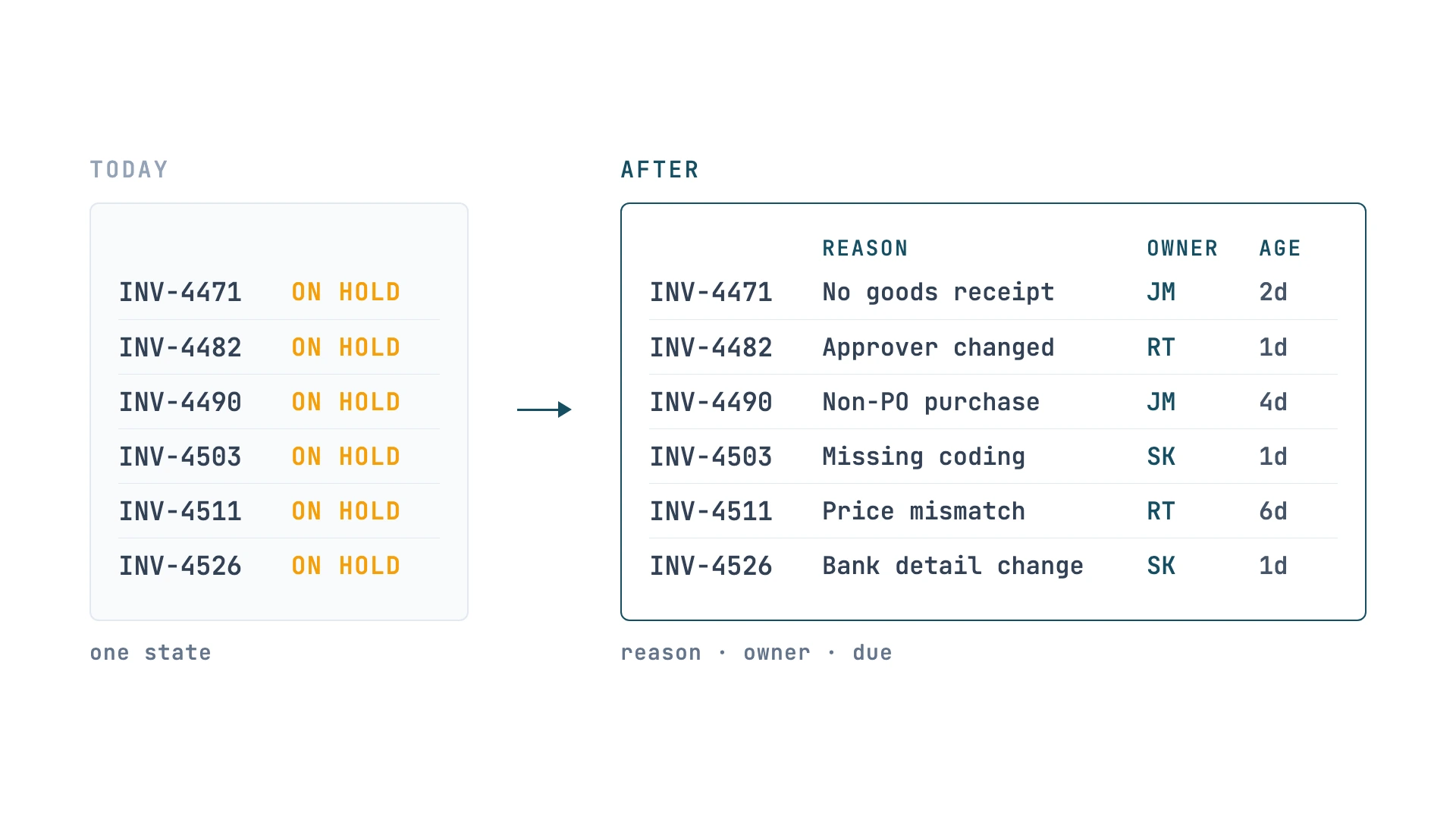
The workflow should also keep the right checks in place. Supplier bank-detail changes and payments still need independent verification. 5 A faster process doesn't help if it creates a bigger control problem later.
Before we change anything, we agree on what to track and how to track it. This may include:
- receipt-to-approval time;
- approval performance;
- exception rate and exception age;
- manual-touch rate and rework;
- overrides and duplicate-risk events; and
- payment-control failures.
We use the same definitions after the change, so the numbers stay comparable. Your firm can then see what improved, what still needs attention, and where to go next.
Let's start with the invoice workflow that needs attention
If your team has to chase invoices without a clear view of where the process breaks, start with a Finance Workflow Diagnostic. We focus on the part of your accounts payable workflow that needs attention most. You get to see what's happening now and what should change, before you commit to a larger build.
Scope and price depend on your workflow, systems, entities, invoice volume, access, and the evidence available. Once the scope is approved, we'll confirm the commercial range.
Contact us about the invoice workflow that needs attention.
References
- Institute of Financial Operations & Leadership (2025). Accounts Payable Automation Trends 2025. https://acarp-edu.org/wp-content/uploads/2025/06/IFOL_AccountsPayableAutomationTrends_2025-US_compressed.pdf
- Ardent Partners (2024). Accounts Payable Metrics that Matter in 2024. https://tradeshift.com/wp-content/uploads/2024/05/Ardent-Partners-AP-Metrics-that-Matter-in-2024-Tradeshift.pdf
- Payment Times Reporting Regulator (2025). Regulator Update, July 2025. Australian Government. https://paymenttimes.gov.au/sites/ptrs.gov.au/files/2025-07/reg-update-july-2025.pdf
- Scamwatch (2026). Business Email Compromise Scams. Australian Competition and Consumer Commission. https://www.scamwatch.gov.au/types-of-scams/business-email-compromise-scams
- National Anti-Scam Centre (2026). Targeting Scams: Report of the National Anti-Scam Centre on Scams Activity 2025. Australian Competition and Consumer Commission. https://www.accc.gov.au/system/files/targeting-scams-report-2025.pdf
Related guides
View accounts payable guidesWhat Should an Accounts Payable Controls Checklist Include?
An accounts payable controls checklist covering segregation of duties, approval limits, duplicate detection, supplier verification, exception tracking and audit trails.
Why Invoice Approvals Take So Long (and What to Do About It)
Learn why invoice approvals take so long and how businesses can reduce invoice approval delays with better workflows, clear authority and automation.
Accounts Payable Automation: What It Covers and What It Doesn’t
Learn what accounts payable automation covers, including invoice capture, matching, approvals and reminders, and what still requires human review.