Model Context Protocol (MCP)
Learn how Model Context Protocol connects AI agents to external tools and data, what MCP standardises, and where it fits compared with a CLI.
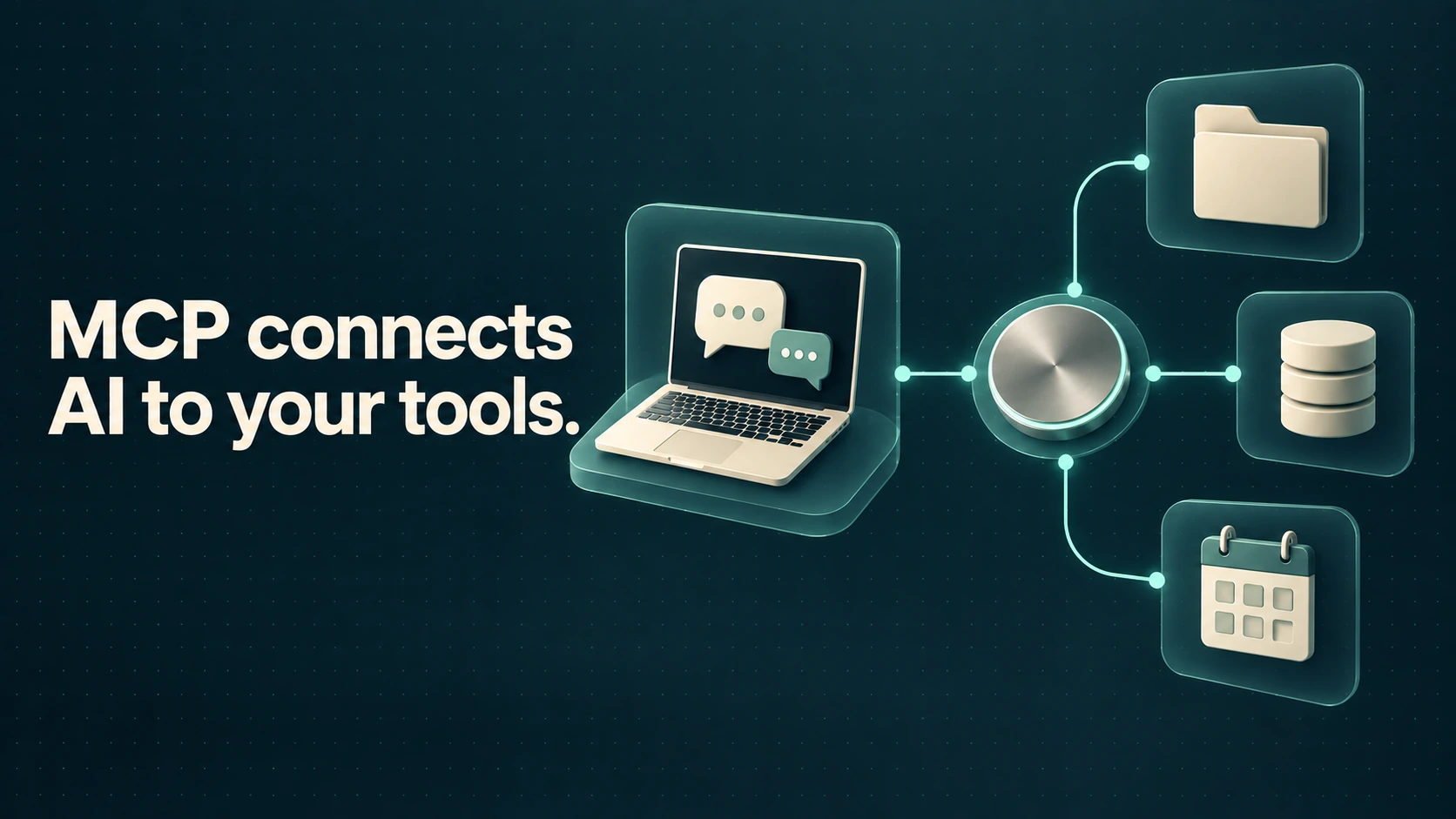
What is Model Context Protocol?
Model Context Protocol (MCP) is an open protocol introduced by Anthropic for connecting AI applications to external tools and data. It gives an AI client and an integration server a shared way to describe available capabilities and exchange structured requests and results.
Before MCP, developers often built a separate integration for every combination of AI application and external service. MCP separates the agent application from the integration, allowing one server to expose a service in a format that several compatible clients can use.
What MCP gives an AI agent
An MCP server can expose actions and information from systems such as email, document platforms, source control, internal APIs, or databases. The AI application decides when to request a capability, while the server handles the connection to the external system.
My mental model for MCP is USB-C. Devices still perform different jobs, but they use a shared connection standard instead of requiring a custom plug for every pairing.
What MCP does not solve
MCP does not decide which tool an agent should use. It also does not make a workflow reliable by itself. Tool selection, permissions, authentication, confirmation rules, error handling, and evaluation still belong to the application around the protocol.
Exposing too many tools at once can also add unnecessary context and make selection harder. The AI agent routing article explains why a model can choose the wrong skill even when the correct one is available.
MCP compared with CLI tools
MCP is useful when an application needs a consistent remote interface, especially in a hosted or sandboxed workflow. A command-line interface can be simpler when the agent runs on a local machine and the software already has a mature CLI.
The right choice depends on where the agent runs, how much context each interface consumes, how permissions are managed, and whether the underlying service already has a stable developer tool. See CLI vs MCP for the full comparison.
MCP reduces repeated integration work, but it remains one part of a larger AI agent system.
Keep up with what I'm working on
I'll send you occasional emails about new articles, tools and offers that could help with your business.